
When Direct Suppression Is the Right Choice: Design Conditions, Risk Profiles, and Architectural Fit
Introduction: Direct Suppression as an Architectural Decision
Direct fire suppression is often described as a simpler or more compact alternative to larger, engineered systems. This framing is misleading. Direct Low-Pressure (DLP) suppression is not a reduced version of indirect suppression, nor is it a cost-driven compromise. It is a distinct architectural response to specific enclosure-level fire risks.
At the micro-enclosure scale, fire protection is governed less by system capacity and more by response timing, proximity, and environmental behavior. In this context, direct suppression exists to address a particular class of problems: fires that originate in tightly confined volumes, escalate rapidly at the point of ignition, and can be effectively extinguished through immediate, localized intervention.
The purpose of this article is not to explain how direct suppression systems operate mechanically. That foundation is established elsewhere. Instead, this page focuses on when direct suppression is the correct architectural choice, and why applying it outside those conditions can undermine reliability rather than enhance it.
The Core Design Philosophy of Direct Suppression
The defining characteristic of direct suppression is locality. Detection and discharge are intentionally coupled to the same physical zone, allowing the system to respond precisely where abnormal thermal conditions arise. Rather than attempting to condition an entire enclosure volume, direct suppression intervenes at or near the point of ignition.
This philosophy prioritizes immediacy over distribution. The system is designed to react during the incipient phase of a fire, before heat release rates increase and before secondary fuels become involved. In such scenarios, extinguishment does not require uniform agent concentration across an entire volume. It requires rapid disruption of combustion at the source.
Direct suppression architectures embrace mechanical certainty. They minimize dependencies on external power, complex control logic, and multi-stage decision pathways. In environments where detection can be placed close to likely ignition points, this simplicity is not a limitation—it is a reliability strategy.
Enclosure Characteristics That Favor Direct Suppression
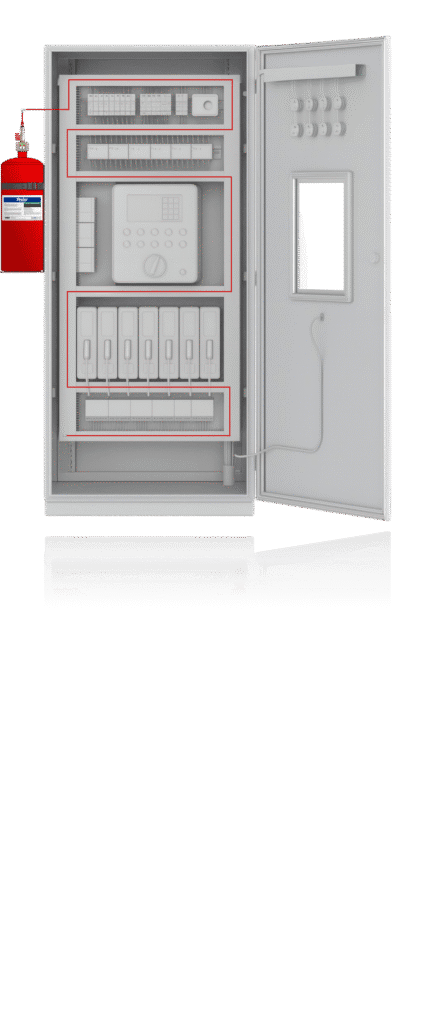
Direct suppression is best suited to enclosures that are small, compact, and well-defined. These are environments where the physical distance between potential ignition sources and the suppression mechanism is minimal, and where internal geometry does not significantly obstruct agent delivery.
Such enclosures typically exhibit:
- A single primary volume rather than multiple compartments
- Limited internal airflow complexity
- Clear identification of high-risk components or zones
- Short thermal and physical paths between ignition and discharge
In these conditions, a localized discharge can effectively overwhelm the fire before it spreads. The enclosure does not need to be sealed to retain agent for extended durations, because suppression occurs before large-scale heat accumulation or gas dilution becomes relevant.
As enclosure size increases, or as internal geometry becomes more complex, the assumptions that support direct suppression begin to erode. This is not a failure of the architecture, but a signal that a different architectural approach may be required.
Fire Risk Profiles Suited to Direct Suppression
Direct suppression aligns well with fire risks that are predictable in origin and limited in scope. Many enclosure fires fall into this category, particularly those involving electrical and electronic equipment.
Common examples include:
- Overheated conductors or terminals
- Loose electrical connections leading to resistive heating
- Component-level failures in power supplies or control modules
- Arcing or sparking events within confined spaces
These fire scenarios tend to originate at specific points and escalate locally before spreading. When detection is positioned in proximity to these risk zones, direct suppression can interrupt the fire during its earliest phase.
In contrast, fires involving diffuse fuel loads, multiple ignition points, or widespread combustible materials are less suitable for localized intervention. In such cases, total-flood strategies become necessary to ensure comprehensive coverage.
Detection and Response Timing Considerations
The effectiveness of any suppression system is constrained by detection timing. Direct suppression is particularly sensitive to this relationship because it relies on early, localized detection to succeed.
When detection occurs near the ignition source, response times are minimized. Suppression can be initiated while the fire is still thermally concentrated and before enclosure conditions change significantly. Under these circumstances, a localized discharge can extinguish the fire without requiring volume-wide agent distribution.
If detection is delayed—either due to distance, airflow interference, or inappropriate sensing logic—the advantage of direct suppression diminishes. The fire may grow beyond the capacity of a localized response, or heat may spread to adjacent components.
This dependency reinforces a central principle: direct suppression is not forgiving of poor detection strategy. It performs best when detection logic is explicitly designed for enclosure-level behavior.
Environmental and Operational Conditions Favoring DLP
Direct suppression is particularly advantageous in environments where autonomy and resilience are critical design goals. Because DLP systems can operate without external power or complex control infrastructure, they are well suited to assets that must remain protected under adverse conditions.
Such environments include:
- Remote or unmanned installations
- Infrastructure embedded within larger systems
- Assets exposed to unreliable power availability
- Applications where maintenance access is limited
In these contexts, reducing system dependencies enhances operational reliability. A mechanically actuated suppression system that remains functional during power loss or communication failure can provide a level of protection that more complex systems cannot.
Direct suppression also minimizes the scope of post-event disruption. Because discharge is localized, the impact of an activation is confined to the affected enclosure rather than extending to adjacent systems or spaces.
System Reliability and Failure Tolerance
Reliability in fire suppression is often associated with redundancy and complexity. Direct suppression adopts a different strategy: failure avoidance through simplicity.
By reducing the number of components involved in detection and activation, direct suppression systems inherently reduce potential failure points. There are fewer interfaces, fewer dependencies, and fewer conditions that must be satisfied before activation occurs.
This does not mean that direct suppression systems are immune to failure. Mechanical damage, improper placement, or environmental degradation can compromise performance. However, when failures do occur, their impact is typically localized rather than systemic.
In contrast, architectures that rely on centralized logic or shared distribution networks can experience cascading failures if a critical component is compromised. Direct suppression accepts localized risk in exchange for systemic resilience.
Where Direct Suppression Is Often Misapplied
Direct suppression is sometimes applied in environments that exceed its architectural intent. These misapplications often stem from equating system simplicity with universal applicability.
Common misalignment scenarios include:
- Large enclosures with significant internal airflow
- Multi-bay or compartmentalized cabinets
- Environments requiring guaranteed uniform agent concentration
- Applications where ignition points are diffuse or unpredictable
In these cases, a localized discharge may not reach all affected areas, or may be diluted before achieving extinguishment. Attempting to compensate by increasing agent quantity or discharge pressure undermines the core design logic of direct suppression and introduces new risks.
Recognizing these limitations is essential. Direct suppression is not inferior in these scenarios—it is simply not the correct architectural tool.
Direct Suppression in a Layered Fire Protection Strategy
Direct suppression is most effective when viewed as one layer within a broader fire protection strategy, rather than as a standalone solution.
At the enclosure level, it provides rapid, localized intervention. At the room or facility level, other systems may address secondary risks, smoke management, or occupant safety. These layers are complementary, not redundant.
In many facilities, direct and indirect suppression architectures coexist. Direct suppression may protect individual control panels, while indirect systems protect larger switchgear rooms or equipment suites. This architectural diversity allows each risk to be addressed with the most appropriate response.
Layered design acknowledges that no single system can optimally address every fire scenario.
Relationship to DLP vs ILP Architectural Comparison
This article addresses the question of when direct suppression is appropriate. It does not attempt to position DLP as superior to ILP, nor does it repeat the mechanical distinctions between the two architectures.
Those comparisons are addressed in the broader architectural discussion of direct versus indirect suppression. Here, the focus is on contextual fit: matching system behavior to enclosure characteristics and risk profiles.
Understanding when to apply direct suppression is inseparable from understanding when indirect suppression is required. Both architectures exist because enclosure fires are not uniform problems.
Closing Perspective
Direct suppression is not a simplified solution for small problems. It is a precise architectural response to specific fire behaviors within confined environments. When applied under the right conditions—compact enclosures, identifiable ignition zones, and early detection—it offers speed, reliability, and minimal disruption.
The success of direct suppression depends on understanding enclosure behavior, not on maximizing system complexity. By treating direct suppression as a deliberate design choice rather than a default option, engineers and designers can ensure that it is applied where it performs best—and avoided where it does not.
In micro-enclosure fire protection, correctness of architecture matters more than magnitude of response.