
What Is a Micro Fire Suppression System? The Complete Guide
Orbis Fire Suppression Guide | 10 min read
Table of Contents
Introduction to Micro-Fire Suppression
Most electrical and industrial fires start in the hidden confines of equipment enclosures – inside control panels, server racks, battery cabinets, and machinery housings – rather than out in the open space. These micro-environments pose a unique challenge: a fire can ignite and grow unnoticed inside a cabinet until it erupts outward, by which time significant damage is done. Traditional room sprinklers or handheld extinguishers cannot detect or reach a small incipient fire inside a closed panel. To bridge this gap, micro fire suppression systems are installed directly inside electrical and industrial cabinets to automatically detect and extinguish fires at the source.
Targeted micro-enclosure suppression is a pre-engineered fire protection approach designed for cabinet-level risks. It typically involves a self-activating suppression unit (often using a pressurized heat-sensitive tube and a clean extinguishing agent) placed within the enclosure. When a flame or intense heat occurs, the system triggers within seconds to flood the interior with an extinguishing agent, quenching the fire before it can spread. This rapid, localized response is critical in high-value technical environments where even a small fire can lead to catastrophic downtime or safety hazards.
Unlike large room-based suppression (which floods an entire room with agent after smoke detectors go off), micro suppression focuses protection exactly where fires ignite. By being inside the cabinet, these systems detect fire conditions (heat, smoke, flame) immediately at the point of origin and act in under 2 seconds from ignition in many cases. For installers and engineers, this means greater reliability and speed in mitigating fires, with minimal collateral damage. It’s a proactive strategy that not only complements building-level fire protection but prevents many fires from ever growing large enough to activate those broader systems.
In the sections below, we’ll delve into how micro fire suppression works, the two main system types (direct vs indirect low-pressure), key components, and how to integrate these systems. We’ll also compare enclosure protection to traditional room systems, outline the advantages for various applications, and discuss the agents used (from clean gases like FK-5-1-12 and HFC-227ea to ABC dry powder). References to NFPA standards (e.g. NFPA 75, NFPA 2001) and UL certifications are included to ensure technical clarity and compliance. Whether you’re an installer designing a panel suppression layout or an engineer evaluating solutions for critical equipment, this guide will provide a comprehensive, SEO-optimized pillar overview of micro fire suppression systems.
How Micro Fire Suppression Works
A micro fire suppression system is essentially a self-contained automatic extinguisher installed within an enclosure. The core operating principle is straightforward: detect a developing fire and discharge an agent directly onto it before it grows. Here’s a step-by-step breakdown of how these systems typically work inside an electrical or industrial cabinet:
- Heat/Flame Detection: A heat-sensitive polymer tubing is routed through the cabinet near high-risk components (e.g. circuit breakers, bus bars, battery cells). This tube is pressurized with an inert gas or the agent itself, and it serves as a continuous linear detector. When a fire or intense heat occurs, the portion of tube closest to the heat source softens and ruptures open. The tubing is engineered to burst at a specific temperature (often around 110–180 °C, depending on material), effectively sensing the fire at its earliest stage.
- Automatic Agent Release: Once the tube ruptures (or another detection device triggers the system), it causes a rapid drop in pressure that opens the valve of the attached agent cylinder. In a Direct Low-Pressure (DLP) setup, the tube itself acts as the discharge outlet – the rupture hole becomes a miniature nozzle spraying agent straight at the flames. In an Indirect Low-Pressure (ILP) setup, the pressure loss or an electronic signal activates a separate valve (often a solenoid valve) which diverts the agent through dedicated pipes and nozzles installed in the enclosure. In both cases, the clean extinguishing agent (gas or powder) is released within seconds, flooding the immediate area around the fire.
- Fire Suppression and Containment: The discharged agent quickly suppresses the fire by cooling it and/or chemically interrupting the combustion. Clean gaseous agents like FK-5-1-12 or HFC-227ea work by rapidly absorbing heat and interfering with the fire’s free radicals, extinguishing flames without leaving residue. In a small enclosed volume, the concentration of agent achieved is typically well above the fire’s extinguishing requirements (design concentrations ~5% by volume for clean agents), ensuring the fire is fully extinguished. The fire is knocked down at the source within the cabinet, preventing spread to adjacent equipment. Because the suppression is localized, there is minimal impact outside the cabinet – often no need to shut down power to other equipment or evacuate an entire room in these micro-incidents.
- No External Power Needed: A key aspect of many micro suppression units is that they can operate autonomously without external electrical power or human intervention. The detection tube mechanism is purely mechanical – it will burst from heat and trigger the system even if the facility power is down or if nobody is present. This failsafe design is crucial for remote or unstaffed installations (like telecom boxes or solar inverter cabinets). Even for systems that use electronic detectors or control panels (as in some ILP configurations), backup power (batteries) or fail-safe pneumatic triggers ensure the suppression will activate in a fire emergency.
- Aftermath and Recovery: Once activated and the fire is out, micro suppression systems typically just require straightforward cleanup and recharge. Clean agents will dissipate without residue (no need for costly cleanup or electronics replacement in most cases), and downtime is minimized. The affected cabinet can often be serviced and back in operation quickly by replacing the spent cylinder or tube. In contrast, if that fire had grown and set off room sprinklers or burned wiring, the downtime and damage would be far greater. In short, micro-enclosure suppression confines the incident to a minor, manageable event instead of a major disaster.
Overall, micro fire suppression works by combining early detection (at the ignition point) with fast-acting suppression right where it’s needed. Next, we will explore the two main system architectures – Direct Low-Pressure vs. Indirect Low-Pressure – which offer different methods to achieve this outcome.
Direct vs. Indirect Low-Pressure Systems (DLP vs. ILP)
Micro fire suppression solutions generally fall into two categories: Direct Low-Pressure (DLP) and Indirect Low-Pressure (ILP) systems. Both are pre-engineered, self-contained systems that operate automatically, but they differ in how the agent is delivered and how the system is activated. Understanding these differences is important for choosing the right system for a given enclosure size or risk profile. Below we break down DLP and ILP, their mechanisms, and use-case distinctions.
Direct Low-Pressure (DLP) Systems
In a Direct Low-Pressure system, the detection tube doubles as the discharge mechanism. This is the simplest configuration. The steps for DLP are:
- Detection & Burst: A pressurized polymer tube (typically flexible, 1/4″ OD) is installed throughout the enclosure near high-risk components. This tube is both sensor and nozzle. When a fire’s heat is detected, the tube ruptures at the hottest spot, instantaneously sensing the fire and creating an opening.
- Agent Discharge through Tube: The moment the tube bursts, the pressure drop causes the attached cylinder to deploy the agent directly through the tube’s burst hole. The tube opening is effectively a nozzle spraying agent right onto the fire source. No separate piping or nozzles are needed – the tube’s rupture point is exactly where the fire is, ensuring extremely targeted suppression.
- Fire Suppression: The released agent floods the small volume around the fire, suppressing it in seconds. Because the tube is routed in close proximity to likely ignition points (wiring bundles, transformers, etc.), DLP systems are highly localized and efficient – they use minimal agent to extinguish flames before the whole cabinet is engulfed.
Example of a direct low-pressure (DLP) micro fire suppression system: a heat-sensitive polymer tube snakes through the enclosure and will rupture at the point of highest heat, spraying the clean agent directly onto the incipient fire. The red cylinder contains the clean agent (e.g., FK-5-1-12 or HFC-227ea) under pressure. In a DLP setup, no additional nozzles or piping are required – the tube itself bursts and acts as the discharge outlet, flooding the area around the flames. This diagram illustrates how a small fire inside a cabinet triggers the tube to rupture and immediately douse the flames.
Key features & benefits of DLP:
- No Power or Electronics: DLP systems are entirely mechanical/pneumatic. There are no moving parts or electrical components required for activation. The fire itself triggers the tube. This makes DLP extremely reliable (virtually no false alarms) and ideal for installations where adding electrical wiring is impractical or where power loss is a concern (remote sites, vehicles, etc.).
- Simplified Installation: With no nozzles or complex piping to install, and no control panel needed, DLP kits are very straightforward. Installers simply mount the cylinder and route the detection tube through the cabinet. This results in a quick setup with minimal modifications to the enclosure. Maintenance is also minimal – mainly just checking tube integrity and cylinder pressure periodically.
- Fast & Localized Response: Because the tube literally detects and bursts at the flame, there is zero delay in agent delivery – it’s as direct as it gets. The fire is attacked at its ignition point, which minimizes damage. Nearby components not involved in the fire get little to no exposure to the agent, and the rest of the facility isn’t disrupted. This localized containment limits downtime to just the affected device rather than a whole room or operation.
- Cost-Effective Protection: DLP systems tend to be lower cost because they have fewer parts (no separate detectors or control units). They also use smaller agent quantities since they only protect the volume of the enclosure. The cost per protected enclosure is attractive for facilities that need to protect many dispersed cabinets on a budget. Additionally, avoiding big cleanups or business interruptions is a huge cost saving when a fire is caught by a DLP system early.
- Typical Applications: DLP is best suited for compact enclosures and point-risk scenarios. For example, small electrical panels, switchgear boxes, battery packs, compact machine control boxes, and telecom equipment nodes are commonly protected by DLP. These are scenarios where a fire is likely to start in one spot and immediate spot suppression is sufficient. DLP is also favored in environments like vehicles, marine, or remote solar/battery units, where its self-contained and power-free nature is a big advantage.
In summary, direct systems offer simplicity and immediacy. If the enclosure is relatively small and the fire hazards are confined (and especially if you want a truly stand-alone solution), a DLP system is often the go-to choice.
Indirect Low-Pressure (ILP) Systems
An Indirect Low-Pressure system uses the detection tube (or other detector) to trigger a separate suppression discharge mechanism. In ILP, the agent is not released out of the tube itself, but through dedicated nozzles or diffusers that are part of a piping network. The sequence is as follows:
- Fire Detection: ILP systems can be activated by multiple detection methods. Often a similar polymer tube is present as a pneumatic detector inside the cabinet – when it senses high heat and ruptures, it drops pressure in the line. Alternatively or additionally, electronic detectors can be used: e.g. an aspirating smoke sensor or heat detector in the cabinet, or even gas sensors (for detecting flammable gas buildup). A manual release pull or electric switch can also trigger the system. All these inputs are typically wired to a small releasing control panel or an electric actuator on the cylinder valve.
- Valve Actuation: Upon detection, a valve on the agent cylinder opens, but unlike DLP, it does not dump agent through the tube. Instead, the tube in ILP is sealed and only used to sense pressure. The valve (often a solenoid valve like the Orbis FS520 unit) redirects the flow to a larger outlet port connected to pipes. Essentially, the detection event causes the system to switch from “standby” to “discharge” mode, releasing the agent from the cylinder into the distribution network.
- Agent Discharge via Nozzles: The clean agent (or powder) travels through fixed piping or flex hoses to nozzles positioned throughout the enclosure. These nozzles are strategically placed to cover the interior volume and create a total flood of the cabinet when activated. For example, an ILP system in a large cabinet might have two or four small nozzles mounted at the top, ensuring the agent is evenly spread and reaches into all sections. The discharge is typically fast and forceful, flooding the entire compartment with agent to snuff out the fire quickly.
- Fire Suppression: As with DLP, the agent rapidly suppresses the fire, but ILP is designed to handle larger volumes or more complex layouts. Because nozzles can be placed in different sections of an enclosure (or even in multiple connected enclosures off one cylinder), ILP can protect broader areas. The clean agents used (FK-5-1-12, HFC-227ea, etc.) are effective on Class A, B, and C fires, meaning they can tackle electrical fires as well as flammable liquid or plastic combustion inside the cabinet. The fire is extinguished, and typically an alarm signal is triggered via the control panel to notify that a discharge has occurred.
Example of an indirect low-pressure (ILP) fire suppression system inside a cabinet: a heat-sensing tube or other detector triggers a solenoid valve on the agent cylinder, which then routes the extinguishing agent through a pipe network and out multiple nozzles to flood the enclosure. In this diagram, the red cylinder stores the agent, but unlike DLP, the agent travels through a steel conduit (piping) to spray nozzles distributed across the cabinet’s ceiling. The heat-sensitive tube still runs through the enclosure to detect fires, but when it ruptures it causes the valve to open rather than directly releasing agent. ILP configurations are ideal for larger or segmented cabinets where broad coverage is needed.
Key features & benefits of ILP:
- Protects Larger/Complex Enclosures: ILP systems can cover bigger cabinet volumes or those divided into sections (e.g. multi-bay control panels, server rack rows) more effectively than a single tube discharge. By using multiple nozzles and directed flow, the agent can reach into every corner. For instance, Firetrace’s ILP clean agent units up to 20 lb can cover enclosures as large as ~6 ft x 6 ft x 6 ft with a single nozzle arrangement. ILP is generally recommended if the enclosure exceeds the volume or area that a single tube burst can reliably protect.
- Flexible Detection and Control: An ILP system often integrates with a fire alarm control panel (FACP) or releasing module for more sophisticated operation. For example, the Orbis FS-CP250 control panel is a UL-listed unit that can monitor multiple smoke/heat sensors and trigger the suppression release in an ILP setup. This allows for staged alarms (alerting personnel before discharge), remote manual release, and system supervision. The ACSD-H aspirating smoke detector is another component often used with ILP – it provides very early smoke and gas detection inside the cabinet and can signal the panel to actuate suppression even before significant heat buildup. Such integration is valuable in mission-critical installations (data centers, telecom hubs) where maximum warning and control is desired.
- External Mounting Options: Because ILP uses piping and nozzles, the agent cylinder can be mounted outside the cabinet if needed. This is useful when internal space is limited or if you want easier maintenance access. Only the small tubing and nozzles need to be inside, while the cylinder and valve can be on the exterior or in an adjacent area. This flexibility can also allow one larger cylinder to serve multiple small cabinets via separate nozzle lines (with careful engineering).
- Manual and Electrical Activation: ILP systems can offer redundant activation methods – e.g. an electric solenoid can be triggered by a manual push-button, by a remote signal from a monitoring system, or by the automatic detectors. They often have manual release levers or pneumatic actuators as backup. This means an operator who spots danger can manually dump the system before automatic trigger, or conversely, the system can tie into facility emergency circuits (shutting down equipment, ventilation fans, etc., upon discharge for safety per NFPA standards).
- Slightly Higher Complexity & Cost: Because ILP involves more components (valves, nozzles, perhaps an electrical panel and detectors), it is a more complex installation than DLP. Installers need to mount and aim nozzles, run release lines, and wire detectors/panel (if used). The cost is higher per enclosure, so ILP is usually justified for larger equipment or critical situations where that complexity is warranted. The trade-off is a more comprehensive and versatile system that can be tailored to the enclosure’s geometry and integrated into broader safety controls.
When to use which? In summary, DLP is best for small, simple enclosures or unmanned sites where simplicity and independence are paramount. ILP is suited for larger or more valuable enclosures, or where early detection and integration are desired. Both systems ultimately serve the same mission – automatic fire knockdown at the source – but they approach it differently. Often, the decision comes down to enclosure size and risk: for example, a single electrical panel might get a DLP, whereas a long multi-cabinet server rack or an energy storage container might employ an ILP with multiple sensors and nozzles.
Components and Integration
Whether you choose DLP or ILP, micro fire suppression systems consist of a few key components that installers should be familiar with. Understanding how these parts integrate will help in designing and assembling the system correctly. Below are the typical components and how they work together:
- Detection Tube: The polymer detection tube is the heart of most micro suppression systems. It’s a flexible nylon or plastic tube pressurized with nitrogen or air (or with the agent in DLP systems) that runs through the enclosure. In DLP, it both detects and dispenses agent; in ILP, it detects (pneumatically) and triggers the valve. This tube is usually routed around fire-prone components (like above circuit breakers, alongside cable harnesses, near batteries). When it bursts from heat, it either directly emits the agent (DLP) or causes a drop in pressure that a pressure-differential valve senses (ILP). Installation tip: use the provided tube clamps and brackets to secure the tubing within the cabinet, keeping it close (within a few inches) to potential ignition points without obstructing any moving parts.
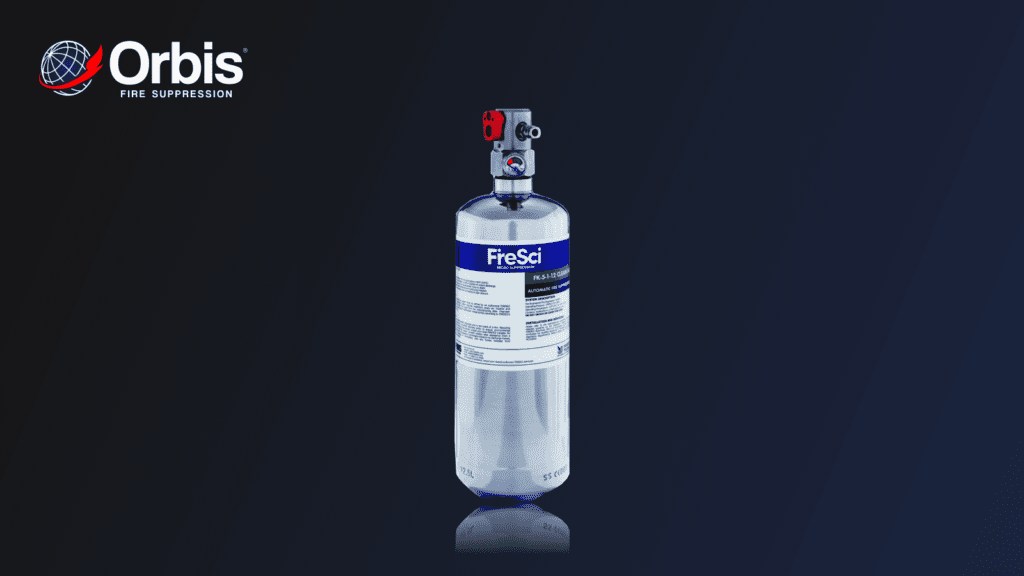
- Agent Cylinder: The cylinder stores the fire suppressant agent in liquid/gas form under pressure. These are typically small cylinders (ranging from ~2–10 lbs of agent for most cabinet systems, though larger ones exist) made of steel or aluminum and pre-filled with the chosen agent. They come with a fill pressure (e.g. 360 psi for Novec 1230) and are equipped with a valve assembly. In DLP kits, the cylinder valve is a pressure trigger type (opens when the tube bursts). In ILP, the cylinder has a solenoid or pneumatic actuator on the valve. Notably, products like the Orbis FS510 and FS520 series are part of this category: for example, the FS510 is a rupture-based discharge valve/nozzle used in DLP setups, and the FS520 is an ILP solenoid valve that controls agent release through nozzles. These valves are critical safety components – designed to stay tightly closed holding the pressure, then open instantly when triggered to let the agent out. They often include ports for a pressure gauge and connections for the detection tube and discharge outlets.
- Discharge Nozzles: In ILP systems, discharge nozzles distribute the agent inside the enclosure. They are typically small brass or stainless steel nozzles with orifice holes sized for the agent flow. Some have 360° spray patterns (for general flooding) while others might have directional fan spray for specific layouts. Nozzles are connected via piping or flexible hoses to the cylinder valve. They must be placed according to design guidelines – e.g., one nozzle per compartment or spaced to cover a certain volume. The Orbis FS510 cross-slit nozzle, for instance, is a special component used in some systems that remains sealed but ruptures in a controlled way when agent hits it, ensuring rapid and even discharge. Proper nozzle placement and sizing ensure the agent concentration will reach fire-extinguishing levels throughout the enclosure (per NFPA 2001 clean agent system requirements). Installers should also note any clearance needed around nozzles (to not block the spray) and use the manufacturer’s guidelines for maximum pipe lengths, bends, etc., to maintain design pressure.
- Fire Detection Devices (optional): While the tube often serves as the primary detector, many ILP systems incorporate additional detectors for redundancy or early warning. These can include: smoke detectors (standard spot detectors or aspirating smoke detection units like ACSD-H which sample air continuously for smoke and even CO gas), heat sensors, or gas detectors (e.g., a hydrogen sensor in a battery cabinet to catch gas buildup). These detectors typically tie into a control module or panel. For example, the ACSD-H can detect a very small amount of smoke (high sensitivity) and trigger an alert or suppression pre-activation. Gas detectors might be set to alarm if flammable gas reaches 25% of its lower explosive limit (LEL), prompting ventilation or suppression. Incorporating detectors can provide a two-stage response: an early alarm to humans (to investigate or prepare) and then if conditions worsen, the automatic suppression dumps.
- Control Panel (Releasing Panel): In systems that use electronic detection or multiple inputs, a fire alarm control panel dedicated to the suppression system is used. A panel like the FS-CP250 is a conventional releasing panel that can monitor up to 4 detection zones and then execute the release by energizing the solenoid valve. The FS-CP250 panel is UL-listed and provides supervisory monitoring, alarm relays, and battery backup. It typically interfaces with the facility’s main fire alarm as well – for example, upon a cabinet discharge, it can signal a supervisory alarm so the event is logged and addressed. For installers, mounting the panel nearby and running wiring for detectors and the release circuit is an added step. However, a panel gives more control: you can have time delays (to allow personnel to safe shutdown before discharge, if the risk assessment permits), abort switches, and status indicators (power, trouble, release) for the system. Small indicator modules or tie-ins to SCADA systems can also be used if a full panel is not desired, depending on the complexity.
- Suppressant Agent: The actual extinguishing medium – discussed more in the next section – is also a “component” in that the system must be filled with the appropriate agent and quantity. Installers must ensure the agent fill matches the design (weight of agent, correct type) and that cylinders are within hydrostatic test date if required. Agents like Novec 1230 (FK-5-1-12) are liquids that vaporize on discharge, whereas dry powder is stored as a fine solid and blown out by nitrogen. Each has different flow characteristics, so the system components (valves, nozzles) are agent-specific in many cases (e.g., a nozzle orifice for powder might differ from a clean agent nozzle to properly distribute the agent).
- Mounting Hardware: Finally, the system comes with various brackets, straps, and fittings to physically install it. There will be a cylinder bracket to mount the cylinder securely inside (or on the side of) the cabinet – important to withstand the thrust during discharge. Tubing connectors and bulkhead fittings allow the detection tube to pass through cabinet walls if needed. Nozzle mounts or clamps fix nozzles in place. Manual release cables (if used) will have pull handles that need to be installed on the cabinet exterior. All these accessories ensure the suppression system is sturdily integrated into the enclosure and will function reliably even in industrial conditions (vibration, etc.).
When properly integrated, these components create a seamless automatic firefighting system inside the cabinet. For example, in a typical electrical panel ILP setup: an ACSD-H detector constantly samples air; if smoke is detected it signals the CP250 panel; the panel then flashes an alert and can trigger a release, energizing the FS520 solenoid valve; the valve opens and Novec 1230 agent rushes out through cross-slit nozzles (FS510) placed above the bus bars, flooding the compartment and suppressing the fire – all in a matter of seconds. Meanwhile, the panel also sends a signal to the building alarm to notify of the event. This interplay of components demonstrates the high-tech yet fail-safe nature of modern micro suppression systems. As an installer or engineer, following the manufacturer’s integration guidelines is crucial – ensure that detection circuits, release circuits, and mechanical tubing are all correctly installed and tested. A final commissioning test (without agent) is often done to verify the detection triggers the valve and alarms.
Fire Suppression Agents for Enclosures
Micro fire suppression systems can employ a few different types of extinguishing agents, each with its advantages depending on the application. The choice of agent impacts the system design, effectiveness on certain fire classes, residue cleanup, and safety considerations. Here we explain the common agents used in cabinet suppression and their characteristics:
- FK-5-1-12 (Clean Agent, a.k.a. Novec™ 1230): FK-5-1-12 is a fluorinated ketone clean agent known for being electrically non-conductive and safe for sensitive equipment. It is a clear, colorless liquid stored at room temperature, which vaporizes when discharged. This agent extinguishes fire primarily by absorbing heat – it has a high heat capacity that cools the flame below its sustainment temperature. FK-5-1-12 is very popular in enclosure protection because it leaves zero residue, is non-corrosive, and after discharge it evaporates without cleanup. Importantly, it has a great safety profile: a large safety margin for occupied spaces with a NOAEL (No-Observed-Adverse-Effect Level) of around 10% volume, and typical design concentrations around 4.5–5.5% (for reference, extinguishing concentration for Class C fires is often ~4%). This means even if some agent leaks out of the cabinet into a room, it’s unlikely to harm people at those levels. FK-5-1-12 is also an environmentally friendly choice, having a global warming potential (GWP) of 1 and ozone depletion potential (ODP) of 0 – it’s considered a sustainable alternative to older halons. NFPA 2001 standard includes FK-5-1-12 clean agent systems, and any system using it should be designed per that standard’s requirements (e.g., concentration, hold time, safety factors). In micro systems, FK-5-1-12 is favored for electronics cabinets, data centers, telecom and battery enclosures where cleanliness and minimal downtime are priorities.
- HFC-227ea (Clean Agent, a.k.a. FM-200®): HFC-227ea is another widely used halocarbon clean agent. It was the dominant halon replacement before FK-5-1-12 came along. HFC-227ea is stored as a liquefied compressed gas and also extinguishes by heat absorption and chemical interference. Like FK-5-1-12, it is safe for electronics and leaves no residue – making it suitable for enclosure protection. Typical design concentration for HFC-227ea in total flooding is about 7–9% for Class A fires (with higher for Class B), but since most cabinet fires are electrical Class C (which is treated like Class A for agents), the concentration is similar, usually around 7%. It also has a decent safety margin, though not as high as FK-5-1-12 (HFC-227ea’s NOAEL is ~9% for most applications). One difference is environmental impact: HFC-227ea has a high GWP (~>3000), so its use is being phased down under climate regulations. Still, many existing systems and some new ones use FM-200, especially in regions where it’s readily available and cost-effective. It’s listed in NFPA 2001 as well. From an installer perspective, FK-5-1-12 and HFC-227ea systems are quite similar in hardware – often the same cylinders and nozzles can accommodate either, with just recalculation of fill weight and nozzle orifice if switching agents. Note: When installing either FK or HFC agent systems in cabinets, ensure the enclosure is reasonably sealed (small vents are okay) so the agent can reach and maintain the design concentration for at least 5–10 minutes of hold time (NFPA 2001 typically calls for 10 min hold time in rooms, but for small enclosures the hold time may naturally be less but still enough to prevent re-ignition). Both agents are electrically non-conductive, so they can discharge on live equipment (important, since many cabinet fires happen in energized gear and powering down may not be immediate or possible).
- ABC Dry Powder (Monoammonium Phosphate): ABC dry chemical is a powdered fire extinguishing agent used in some micro suppression units, particularly in harsh industrial or vehicle settings. The powder works by a combination of melting and coating the fire’s fuel (to block oxygen) and thermal absorption. It is very effective on Class A (ordinary combustibles), Class B (flammable liquids), and Class C (electrical) fires – hence “ABC.” In cabinet systems, dry powder might be chosen for situations like CNC machine cabinets, engine compartments, or heavy vehicle electrical bays, where a bit of residue is acceptable or if the risk includes flammable oils in addition to electrical faults. The advantage of ABC powder is that it can sometimes suppress a fire that has a small continuous heat source better – the powder can smother and stick, whereas a gaseous agent might dissipate. It’s also unaffected by leakages – even if an enclosure is not well sealed, the powder will still settle on the fire. ABC powder systems are usually low-pressure DLP types (for example, a tube bursts and powder is expelled by a nitrogen cartridge). The downside is the cleanup: the powder will coat everything in the cabinet and is mildly corrosive over time, especially if there’s humidity (monoammonium phosphate can corrode metals). Thus, one wouldn’t typically use it in a sensitive server rack unless nothing else is viable. Also, visibility in the cabinet is lost after discharge due to powder cloud. NFPA 17 covers dry chemical extinguishing systems, which these would fall under. Installers using powder should ensure nozzles are designed for powder flow (if ILP) and that the powder remains dry and free-flowing in the cylinder (periodic check for caking is needed). Pro tip: ABC powder can clump, so systems often require vibration or a particular orientation to discharge fully. Adhere to the manufacturer’s specs on mounting positions for powder cylinders.
- Other Agents (CO₂, Foam, etc.): By far, the above three are the most common in micro-enclosure systems. CO₂ is occasionally employed in specialized inerting systems for cabinets (especially in Europe or for ATEX-rated areas) but due to toxicity, it’s used only in unoccupied areas and with caution. CO₂ would function similarly in an ILP method, but it’s less common as a packaged unit for small enclosures today (clean agents have largely replaced it for this use). Water mist or aerosol generators are not typical for standard electrical cabinets, though there are some water mist “micro” systems (like for small turbine enclosures) but those require pumps and are more complex (NFPA 750 governs water mist, not often applied at the single-cabinet scale). In the context of micro fire suppression for electronics, clean agents and dry chemical remain the top choices, with FK-5-1-12 being the premium solution.
In selecting an agent, consider the nature of the protected equipment and the fire scenario. For sensitive electronics or minimal downtime – use a clean agent (FK-5-1-12 is preferred for its cleanliness and green profile). For mixed hazards or cost-critical applications – ABC powder can be a robust and economical choice if one is prepared for the cleanup (e.g., in a remote telecom power box or an industrial control cabinet in a plant where a residue isn’t a deal-breaker). Remember that whichever agent is used, the system should have the appropriate approvals (UL, FM, CE) for that agent’s use in the given system configuration. For instance, many modern cabinet systems using Novec 1230 carry UL 2166 listing and FM approval for their clean agent units – a reassurance that they’ve been tested to extinguish fires effectively and safely in that application.
Use Cases & Applications
Micro fire suppression systems are used anywhere an internal cabinet fire could pose a risk to safety, continuity, or valuable equipment. Let’s explore some common applications and scenarios where these systems are deployed, along with the typical risks and system type used in each:
- Electrical Panels & Switchboards: In commercial and industrial buildings, electrical distribution panels, switchboards, and motor control centers can experience short circuits, overloaded breakers, or arc faults that lead to fires. The risk is high because these fires can spread along cable troughs or cause extensive outage. A DLP or ILP system is often installed directly inside larger panels. Use case: A manufacturing plant outfitted each of its main electrical cabinets with a DLP clean agent unit, ensuring that if a breaker or bus bar ignites, the fire is immediately snuffed and does not take down the whole production line. For very large multi-section switchboards, an ILP system with multiple nozzles may be used to cover each section, possibly triggered by an overall panel heat detector.
- Server Racks & Data Center Cabinets: High-density server racks in data centers or IT rooms carry a lot of electrical load and can have hotspots or electrical arcing, especially with faulty power distribution units or overheated equipment. The airflow in these racks can also spread a flame quickly. ILP systems paired with early smoke detection (like ACSD-H) are a popular solution here. Use case: A data center installs an ILP clean agent system in each rack, connected to an aspirating smoke detector that can sense even a slight smoldering wire. The moment smoke is detected, the system releases Novec 1230, extinguishing the nascent fire with no damage to servers and no residue. After discharge, operations resume within minutes since equipment wasn’t significantly harmed (as opposed to a sprinkler which would be disastrous for electronics). These systems provide peace of mind that a single server short won’t turn into an outage for the whole facility.
- Battery Energy Storage Systems (BESS) & UPS Cabinets: Lithium-ion battery banks and UPS systems concentrate significant energy in a cabinet. The key risks are thermal runaway (a cell overheating and causing chain-reaction fires) and flammable gas release (Li-ion cells can emit flammable electrolyte vapor; lead-acid batteries emit hydrogen gas when overcharging). These fires burn extremely hot and can reignite if the source cells remain in thermal runaway. ILP systems with clean agent and gas detection are often used. Use case: A solar farm’s BESS containers are equipped with an ILP system: a hydrogen detector monitors any buildup (to pre-ventilate if H₂ accumulates) and a thermal sensor or optical detector is inside to catch any flare-up. Upon detection, the system floods the battery cabinet with FK-5-1-12, suppressing flames and preventing fire spread to adjacent battery modules. The hydrogen sensor ensures that if flammable gas reaches a dangerous concentration, it triggers ventilation or an alert – preventing an explosion that could otherwise occur. While no system can easily “stop” a thermal runaway once it starts in a cell, this setup buys time and limits fire propagation, and when combined with proper battery management and ventilation per NFPA 855 (Standard for Energy Storage Systems), greatly reduces the hazard.
- CNC Machines & Industrial Equipment Enclosures: Many industrial machines (CNC mills, injection molders, printing presses, etc.) have internal electrical cabinets or compartments with combustible lubricants and wiring. Risks include motor overheating, oil mist ignition, or electrical shorts. These are often in harsh environments (vibration, dust). DLP systems using either clean agent or dry powder are commonly fitted to machine cabinets. Use case: A CNC machining center has a small control box and a separate compartment where cutting oil is present. A DLP tube system with ABC powder is installed in the latter – if a hydraulic line leaks and catches fire, the tube bursts and powder knocks it down immediately, preventing a shop fire. In the electrical control box, a DLP clean agent unit is used instead to avoid powder residue on the PLC electronics. By tailoring the agent to the compartment, the facility achieves optimal protection. The DLP design was chosen because these systems are stand-alone and require no power, meaning even if the machine’s power is cut during an emergency, the suppression will still work. Plus, DLP’s simplicity made it easy to retrofit onto older machines without complex integration.
- Telecom & Network Cabinets (Indoor/Outdoor): Telecom infrastructure often involves many distributed cabinets (cell tower equipment boxes, roadside fiber optic cabinets, ISP network hubs). These can be in remote or unmanned locations, so a fire might smolder undetected until the whole cabinet is destroyed. Causes include power supply failures, lightning surge damage leading to arc, or overheating components. Compact DLP or ILP systems with combined detection are ideal here. Use case: A telecom operator installs DLP clean agent kits in outdoor 5G equipment cabinets. Each kit has a small manual release on the outside of the cabinet as well, in case a technician is on site and sees danger (otherwise, it will auto-activate if needed). Because these are often unmanned, the self-actuating nature is key. Some cabinets also include a temperature sensor that, if the internal temp spikes abnormally (potentially indicating a fire before smoke starts), triggers an alarm or the suppression. The result is improved network reliability – a cabinet fire that could cut service for thousands of customers is now a rare and quickly mitigated event.
- Power Utility Equipment (Transformers, Switchgear, Battery Rooms): Utilities sometimes use local suppression for critical gear. For example, hydrogen monitoring in battery rooms coupled with suppression, or small CO₂ units on transformers. One use case: power substations with enclosed switchgear have ILP systems with heat or flame sensors that trigger clean agent discharge, preventing a small arcing fault from becoming a substation fire. Also, wind turbines use compact suppression in the nacelle and electrical cabinets at the base – these are often DLP systems because they’re in remote, high-vibration settings where simplicity is golden. As another example, if there is a chemical process enclosure or gas storage cabinet, one might integrate gas detection with an ILP suppression system such that if a gas leak reaches a dangerous level or if a flame is detected, the system activates and possibly also triggers vents. These tailored use cases show the flexibility of micro suppression for various industrial scenarios.
In all these applications, a common theme is that micro suppression limits the fire damage to within the equipment, often preventing escalation to a room fire. Many facility insurers and codes are recognizing these benefits. NFPA 75 (the standard for IT equipment protection) even notes that in-cabinet suppression can be employed for enhanced protection of critical systems, as long as the detection of those systems is tied into the main alarm to notify responders. For engineers, when designing a fire protection strategy, think of micro suppression as the first line of defense for high-risk cabinets, with the building sprinklers or room clean-agent system as the second layer if things go really awry. This multi-layer approach significantly improves overall safety and resilience.
Comparing Cabinet vs. Room Fire Protection
It’s important to understand how micro-enclosure suppression systems compare to traditional room-level fire protection (like sprinkler systems or total-flood clean agent systems for the entire room). Each approach has its role, and they are not mutually exclusive. In fact, they often complement each other. Here are the key differences and comparative points:
- Detection Speed and Fire Size: Cabinet systems detect a fire much sooner because the sensor (tube or detector) is inside the enclosure right next to potential ignition points. A room-level system (e.g. smoke detector in the ceiling) will only sense a fire in a cabinet after smoke escapes the enclosure and rises, which could be well into the fire’s growth. By that point, the fire might have spread beyond the equipment. Micro systems catch it at the incipient stage, often when the fire is just a few kilowatts or less in size. This means the fire is far smaller and easier to extinguish, resulting in less damage. A study of electrical enclosure fires noted that early suppression within the enclosure significantly reduces peak temperatures and prevents flashover beyond the enclosure.
- Targeted vs. Flooding Suppression: A building sprinkler or clean-agent total flood system is designed to suppress a fire in an entire room or area – essentially flooding a large volume based on an average concentration. Micro systems only flood the enclosure volume, which is much smaller (maybe a few cubic feet vs thousands of cubic feet in a room). This targeted approach means less extinguishing agent is needed and other parts of the room are not impacted. For example, if a small fire starts in one rack in a data center and you rely solely on a room clean agent system, you’d dump hundreds of pounds of agent to protect the whole room (and need to shut down HVAC, etc.), whereas an in-rack unit might extinguish it with 5 lbs of agent and no effect on adjacent racks. One does not preclude the other – you can have both, and the room system provides backup if the in-cabinet system fails or a fire starts outside a protected cabinet.
- Minimized Collateral Damage: Room sprinklers, while highly effective at life safety and structure protection, will drench everything in the room with water when activated – which is obviously undesirable for electronics. Clean agent room systems avoid water damage but a large dump can still cause thermal shock to running servers and requires evacuating personnel until the gas is vented. In contrast, micro suppression in a cabinet has little to no collateral damage. It releases a small amount of agent, often does not even require people to evacuate (since it’s confined inside the box), and doesn’t ruin other equipment. It’s the difference between surgery with a scalpel vs. a firehose. This is a huge advantage for business continuity: after a micro suppression event, usually only the one cabinet needs attention, whereas a whole-room event might require hours of cleanup and restart.
- Fire Containment: One might wonder, if the cabinet is closed, why not let the room system handle it? The issue is a closed cabinet can become a mini-oven – heat builds quickly and when the cabinet eventually fails or someone opens it, you get a larger fire release. Room systems are not effective until the fire breaches the enclosure. By then, it could be too late or at least cause significant equipment loss. Cabinet systems stop the fire from escaping the cabinet at all, essentially containing the incident. It’s worth noting that some fire codes and standards (like NFPA 75 for data centers) acknowledge that if you have in-cabinet suppression, you still need to annunciate it (so the building knows there was an event), but it can significantly mitigate the threat.
- Regulatory Requirements: Sprinklers or room systems are often required by code for certain occupancies or large equipment rooms, for life safety and property protection. In-cabinet systems are typically optional, supplemental protection. Having micro-enclosure suppression does not automatically exempt you from needing a room sprinkler or clean agent system if codes mandate them for the occupancy. However, insurance underwriters and owners may push for cabinet systems to protect high-value equipment even if not required, to reduce claims and downtime. There’s also a trend where NFPA standards (like NFPA 76 for telecom facilities, or insurance standards like FM Global data sheets) encourage use of localized suppression in high-risk enclosures to augment overall protection. For engineers, this means micro systems are an additional mitigation measure in the fire risk assessment toolkit, rather than a code requirement. Always check local codes and standards: e.g., if an AHJ (Authority Having Jurisdiction) allows a performance-based design, they might permit a reduction in room-level protection if sufficient in-cabinet protection is installed, but that’s case-by-case.
- Cost Considerations: For a given area with many enclosures, installing a single large clean agent system for the whole room could be more expensive (and definitely more complex) than equipping individual cabinets with mini-systems. For example, protecting 10 server racks with one total flooding system might require a big agent supply, piping throughout the room, and an engineered design with reserve safety factors – easily a significant capital cost. Equipping those 10 racks each with a pre-engineered micro system might come out lower in cost and be easier to scale or modify as the layout changes. On the flip side, if you have a lot of small cabinets, maintaining many individual systems can add up (each with cylinders to check, etc.). A hybrid approach is common: e.g., protect critical enclosures individually and rely on a simpler sprinkler backup for the room. The economics will vary, but generally micro suppression shines for protecting distributed, specific hazards that would otherwise require over-design of a room system.
- Activation and Reset: A room system activation usually triggers facility-wide responses: alarms, HVAC shutdown, possibly power shutdown (for clean agent per NFPA 70/NFPA 75 guidelines to avoid re-ignition sources). It can be a big event to reset – refill agent, bring systems back online, etc. A cabinet system activation is localized; the overall facility can continue running (except whatever that cabinet was doing). You’ll typically just replace the cylinder or tube and reset the small panel. Less downtime and simpler cleanup (if any) is a major benefit. As one example, consider a manufacturing line control panel fire: with a room CO₂ system, you’d dump CO₂, halt the entire production and evacuate; with just a cabinet system, only that line stops and others can keep working, and operators may not even need to leave the area as long as the fire is out and there’s no lingering hazard.
In summary, cabinet micro suppression provides a fine-grained protective layer that addresses what room systems can miss: the very start of a fire, in the place it’s most likely to start. Room-level systems are there for when fires grow larger than a single enclosure or when other combustibles in the room catch fire. Together, they form a robust defense. From an engineering standpoint, adding in-cabinet suppression greatly increases the probability of preventing major fire incidents, and from a business standpoint, it can pay for itself the first time it stops a fire that would have caused hours or days of downtime.
System Advantages in Enclosures
Deploying micro fire suppression in electrical and industrial enclosures offers numerous advantages over relying solely on traditional fire protection. Here we highlight the key benefits, especially from the perspective of installers and engineers who need to justify and implement these systems:
- Ultra-Fast Response: The foremost advantage is speed. By detecting and reacting at the ignition source, micro systems often extinguish a fire in its infancy (sometimes literally within 1–2 seconds of ignition). This speed is unattainable with manual firefighting or even standard detectors, which wait for smoke to reach them or someone to notice. Fast suppression means less damage and less risk of fire spread. In critical processes, this can make the difference between a momentary hiccup and a multi-hour shutdown.
- Reduced Damage & Downtime: Because suppression is confined to the affected equipment, damage is minimized to that equipment alone. Surrounding devices in the room continue operating normally. The extinguishing agents used (clean agents in particular) do not harm electronics when used as designed – no sooty residue, no thermal shock from cold CO₂ discharge, etc. Many times, if a clean agent is dumped and the fire is out quickly, the equipment can be inspected, powered back up, and back in service the same day. This improves uptime dramatically. Dry powder systems do cause residue on-site, but even then, it’s limited to the one enclosure – it won’t, say, spread into ducts or across an entire production floor. The business continuity benefit is one of the biggest drivers for using micro suppression in data centers, telecom, and manufacturing.
- Life Safety and Risk Mitigation: While these enclosure systems are primarily about asset protection, they also reduce risks to personnel. If a fire is snuffed out inside a cabinet, it never grows large enough to threaten occupants or responders. It also may never produce the large volumes of toxic smoke a bigger fire would. By preventing a small flame from turning into an inferno, you’re inherently keeping the environment safer for anyone nearby. Additionally, many micro systems are non-toxic (e.g. Novec 1230 has a wide safe margin), so even if a bit leaks out, it’s not going to harm people – whereas the byproducts of a big uncontrolled electrical fire (like hydrogen cyanide from burning cables) are extremely hazardous. In battery systems, by catching an off-gas or small flare-up early, you might prevent an explosion that could injure people. All that said, one should not assume an enclosure system eliminates all danger – but it certainly buys time and reduces the scale of emergencies that staff might have to deal with.
- No External Power Needed (for DLP): In remote sites or during power outages, a DLP system still stands guard. For example, if a fire breaks out in a telecom cabinet during a grid power failure (running on backup batteries), the DLP tube will activate even if electronic detectors are down, since it needs no electricity. This resiliency is a huge plus in scenarios like off-grid solar installations, disaster resilience for communications, or marine systems on lifeboats, etc. Even ILP systems, though they often use electronics, have the tube backup – e.g., the ILP solenoid valve will open if the tube bursts (a pneumatic trigger) even if the electric signal never came. Thus, the fail-safe design of these systems (with mechanisms like pressure triggers) ensures continuous protection 24/7.
- Scalability and Modularity: Micro suppression units are modular. You can protect one cabinet or a hundred, simply by replicating the units, rather than needing a massive overhaul of a building system. This is great for scalability – e.g., as a data center adds racks, it can equip each new rack with its own suppression rather than re-piping a whole room system. It’s also good for targeted protection in a larger facility: maybe not every cabinet needs it, so you install only where needed (based on risk assessment) without re-engineering the whole facility’s fire system. Installers find these systems relatively plug-and-play – many are sold as kits with all parts included for a standard enclosure size, which speeds up deployment.
- Cost Savings (Long Term): While there is an upfront cost to adding any suppression system, micro systems can save money by preventing large losses. Consider the cost of a single incident: losing a critical electrical panel could halt production, cause expensive machinery damage, or trigger an insurance claim with downtime costs. By avoiding that, the ROI of these systems is often justified after just one saved incident. Additionally, some insurance companies offer lower premiums or incentives for having supplemental fire protection on valuable equipment, as it reduces the risk of a large payout. On the installation side, the simplicity of DLP systems in particular means lower labor costs to install compared to traditional systems (no extensive pipefitting or wiring). Maintenance is also straightforward – periodic checks and maybe replacing a tube every few years if it shows wear (which is inexpensive).
- Compliance and Standards: As mentioned, standards like NFPA 75 and NFPA 76 are increasingly recognizing these systems. Having micro suppression may help in meeting certain regulatory requirements or internal safety standards for mission-critical facilities. For instance, a financial data center might adopt an internal policy that all server racks over a certain kW have in-rack suppression, to align with NFPA guidelines for enhanced protection of IT. In utility applications, fire codes for energy storage (NFPA 855) often require some form of early detection and suppression – a cabinet clean agent system could help satisfy that by demonstrating you can control a battery fire before it propagates. Moreover, using UL-listed systems (UL 2166 for clean agent units, UL 2127 for inert gas, UL 268 for detectors, etc.) ensures that the equipment meets safety benchmarks and will perform as expected in a fire scenario.
- Non-Disruptive to Operations: One often overlooked advantage is that these systems, when not actively fighting a fire, are non-disruptive. They sit quietly in the cabinet, requiring almost no space (tubing and a small cylinder often mount out of the way). They don’t interfere with the equipment’s normal function or the work environment. There are no false alarms causing system dumps, in general – the systems are quite robust against nuisance activation (the tube requires high heat to burst, far above normal ambient). This reliability means you can set it and forget it, aside from routine maintenance, without worrying that it will cause downtime. Contrast this with some very sensitive smoke detection systems that might trip false alarms and cause unnecessary shutdowns; the cabinet suppression concept avoids that by design (physical activation only when real heat/fire is present).
In a nutshell, micro-enclosure suppression adds a high-value safety net under your critical systems. For engineers, it’s an elegant solution to a vexing problem – how do we stop a fire where it starts, in an enclosed space, without waiting for big systems to kick in? For installers, it’s a relatively straightforward addition that can be a selling point to clients looking to protect their investment and ensure business continuity. The advantages make it clear that while not every enclosure in the world will need its own suppression, those that do can greatly benefit from it.
Standards and Compliance (NFPA/UL)
When implementing micro fire suppression, it’s essential to consider relevant standards, codes, and certifications to ensure the system is compliant and effective. Here are some key standards and guidelines that apply:
- NFPA 75 – Protection of IT Equipment: NFPA 75 is the standard that covers fire protection for data centers and IT rooms. While it focuses largely on room protection (sprinklers, clean agents, detection, etc.), the 2020 edition explicitly acknowledges in-cabinet suppression systems. It states that if cabinets have internal suppression, the detection system for those must annunciate an alarm for each cabinet or group of cabinets releasedr. In practice, this means if you install say a clean agent unit inside a server rack, you should interlock it so that when it fires, a signal is sent to the main fire alarm (even if the fire is out, the event needs logging). This is usually done via a pressure switch on the cylinder or a relay from the control panel operating the suppression. NFPA 75 doesn’t mandate in-cabinet systems, but if you use them, follow these rules. It also suggests giving consideration to gaseous agents inside units for rapid protection of equipment (Annex material). So in a way, NFPA 75 encourages their use for critical equipment protection as part of a holistic strategy.
- NFPA 2001 – Clean Agent Extinguishing Systems: NFPA 2001 is the primary standard for design and installation of clean agent systems (like FK-5-1-12, HFC-227ea, etc.). While it mainly addresses total flooding systems in rooms, many principles carry over to micro systems. For example, it covers agent concentration requirements for various fuels and the safety limits in occupied spaces. A micro system using Novec 1230 should be sized to achieve at least the minimum design concentration for Class C hazards (often 1.3 times the extinguishing concentration) in the enclosure volume. It should also consider the “hold time” – though small enclosures inherently confine the agent well unless there are big vents. NFPA 2001 also requires certain signage (if clean agent present, label the enclosure perhaps) and maintenance schedules for cylinders, etc. Engineers should use NFPA 2001 as a guide to ensure that, even at small scale, the clean agent system will perform – for instance, that the agent’s discharge time is within 10 seconds, etc., which is usually easily met in micro systems. Note: NFPA 2001 references UL/FM listings – it’s good practice (and often required by AHJs) to use UL-listed clean agent units and UL-approved clean agents. As mentioned earlier, many micro systems have UL 2166 listing (UL Standard for Halocarbon Clean Agent Extinguishing System Units). Check that the particular combination of cylinder, valve, agent, and nozzle has a listing for the intended application or an FM approval.
- NFPA 17 & 17A – Dry Chemical and Wet Chemical Systems: NFPA 17 covers dry chemical systems. If an ABC powder micro system is installed, theoretically NFPA 17’s guidance on installation (pipe sizes, nozzle flow rates, coverage) should be followed, as applicable. NFPA 17 tends to address larger kitchen hood or industrial systems, but the basics (like ensuring concentration and coverage, and that the system is designed by qualified persons) apply. There is also UL 1254 which is the standard for pre-engineered dry chem units – ensure any powder unit has been tested to a standard, likely it will carry a CE mark or UL component recognition.
- NFPA 70/National Electrical Code (NEC): The NEC (particularly Article 645 for IT equipment rooms and Article 240 for arc energy reduction) doesn’t directly talk about fire suppression, but it has related issues. For instance, NFPA 70 requires disconnecting power when certain suppression systems activate in IT rooms (to avoid electrical re-ignition or safety hazards). While this often applies to room systems, one might integrate a micro system’s activation with a power shutdown of that particular equipment (for safety, since continuing to power a piece of gear that just had a fire might be dangerous). Not mandatory in all cases, but something to consider. Also, NEC requires labeling of power sources – after a suppression discharge, any emergency power-off (EPO) for that equipment should be clear. These are design integration points more than code restrictions on the suppression system itself.
- UL Listings and FM Approvals: When selecting a micro suppression product line, it’s advisable to choose equipment that has recognized certifications:
- UL Listing: UL has categories for these systems. UL 2166 (Halocarbon Systems) and UL 2127 (Inert Gas Systems) are typical for clean agent setups; UL 2775 is for aerosol systems. If the system uses a detection tube, UL 521 (Heat Detectors) or UL 268 (Smoke Detectors) might not directly apply to the tube, but UL has examined some tube systems under their own protocols. For example, some manufacturers list their units as “UL Listed Pre-Engineered Suppression System Unit.” The FS-CP250 control panel we discussed is UL listed as a fire control unit, meaning it meets UL 864 standard – that’s important for the reliability of the alarm and releasing circuit. The fact that “All new FK-5-1-12 ILP systems carry UL Listing and FM Approval” as Firetrace notes indicates that reputable systems should have those marks. UL listing assures the AHJ that the system was tested for fire efficacy and hardware function. As an installer, using listed systems can simplify approval – you’ll provide the cut sheets showing UL or FM markings in your submittals.
- FM Approval: FM Global (a large insurer) also certifies systems. FM’s standards might be slightly different (FM 5600 series for clean agents). Having FM Approved equipment can be beneficial if the site’s insurer is FM Global or requires FM compliant designs. Some clients explicitly require FM Approved solutions for critical facilities.
- UL Listing: UL has categories for these systems. UL 2166 (Halocarbon Systems) and UL 2127 (Inert Gas Systems) are typical for clean agent setups; UL 2775 is for aerosol systems. If the system uses a detection tube, UL 521 (Heat Detectors) or UL 268 (Smoke Detectors) might not directly apply to the tube, but UL has examined some tube systems under their own protocols. For example, some manufacturers list their units as “UL Listed Pre-Engineered Suppression System Unit.” The FS-CP250 control panel we discussed is UL listed as a fire control unit, meaning it meets UL 864 standard – that’s important for the reliability of the alarm and releasing circuit. The fact that “All new FK-5-1-12 ILP systems carry UL Listing and FM Approval” as Firetrace notes indicates that reputable systems should have those marks. UL listing assures the AHJ that the system was tested for fire efficacy and hardware function. As an installer, using listed systems can simplify approval – you’ll provide the cut sheets showing UL or FM markings in your submittals.
- Local Fire Codes and Approvals: Always check if local jurisdiction has any specific requirements or permit processes for these systems. Many places treat a pre-engineered cabinet suppression system similarly to a fire extinguisher or an appliance protection system – you might need to submit plans, get an inspection after install, and perform annual maintenance inspections. Also, if tying into a building fire alarm, you’ll likely involve a fire alarm contractor to ensure the signals (supervisory alarms, etc.) are configured properly in the main panel to avoid confusion in alarm monitoring.
- Maintenance Standards: NFPA 25 (for water-based) doesn’t cover these, but NFPA 72 (fire alarm code) would cover the detection aspects (e.g., any smoke detector used in the system must be maintained per NFPA 72 schedules). NFPA 2001 has a chapter on inspection, testing, maintenance of clean agent systems – which you should adapt to micro systems (e.g., weigh or pressure-check cylinders semi-annually or per manufacturer, visually inspect the tube for damage or looseness, etc.). NFPA 10 could be loosely applied if these are considered fixed “extinguishers” – meaning you should train personnel on usage and what to do if one goes off (like treat it similar to a fire extinguisher discharge in terms of response).
In summary, compliance is about ensuring the micro suppression system is not a wildcard but an integrated part of the facility’s fire protection plan. Using standards-approved equipment and following guidelines like those in NFPA 2001 will result in a system that authorities will be comfortable with and that will perform when needed. Always consult the latest edition of relevant NFPA standards and the manufacturer’s listed design manual when engineering these systems. For instance, if protecting a data center cabinet, document that it’s being done in accordance with NFPA 75’s recommendations and the clean agent system is per NFPA 2001 – that way, everyone (from client to inspector) is on the same page regarding the system’s role and reliability.
Fire Risk Scenarios in Cabinets
Let’s drill down into some specific fire risk scenarios that micro suppression systems are designed to address. Understanding these helps in both designing the protection and explaining to stakeholders why suppression is needed inside an enclosure:
- Electrical Arcing and Short Circuits: Electrical cabinets contain bus bars, breakers, contactors, and lots of wiring – all of which carry current. A loose connection or insulation failure can cause an arc flash or short circuit, essentially a small explosion or intense discharge of heat. Arcs can readily ignite cable insulation, plastic terminal blocks, or nearby wire bundles. In fact, statistics show a majority of workplace electrical fires start due to such electrical failures or malfunctions. These arc-induced fires start very fast (an arc flash instantly can exceed 19,000 °C at its core), so having a tube that ruptures from the heat immediately is crucial. Micro suppression will detect the arc’s heat and flame within moments, suppressing the resulting fire before it can spread along cable runs. Also, since arcs often blow out panel doors or vent hot gases, the rapid discharge of a clean agent can cool and inert the atmosphere, potentially preventing secondary flashovers. It’s worth noting that an arc fault within a closed cabinet might self-extinguish once the breaker trips, but it can leave behind burning insulation. The suppression system deals with those lingering flames. Real scenario: An overloaded terminal in a control panel arcs and starts charring a wire bundle. The DLP tube above it bursts and dumps FM-200, snuffing the flames. The only damage is a charred wire that needs replacement, rather than a whole cabinet gone. Meanwhile, an alarm was signaled so maintenance knew to check that panel. This kind of incident happens in seconds – without suppression, that small arc could have built into a larger fire before anyone knew.
- Overheated Components (Overload Fires): Not all electrical fires are dramatic arcs; some are slow burn-outs. A motor contactor stuck closed, an overloaded transformer, or a bearing overheating can cause a component to smolder and eventually flame. These often produce smoke and a lot of heat before open flaming occurs. An aspirating smoke detector (ACSD-H) can catch the early smoke in an ILP system, triggering an alarm or even a suppression dump before flames appear. But even if using just heat detection, the moment that overheating device reaches the tube’s activation temperature, suppression will trigger. The risk scenario here is the fire might be relatively small but in a sensitive area – e.g., a smoldering UPS inverter board can fill a telecom cabinet with smoke that destroys circuits via soot. By extinguishing it early, you minimize smoke damage. Thermal sensors and even simple thermostats can also be used to sense overheat conditions. Some advanced systems use thermal cameras inside cabinets (rare, but possible) to monitor hotspots and activate suppression if a threshold is exceeded. This is more in custom setups; most will rely on the tube or a fixed heat detector (like 141 °C fixed temperature) to trip.
- Thermal Runaway in Lithium Batteries: One of the most challenging scenarios. Lithium-ion cells, when experiencing thermal runaway, can release their stored energy as heat, causing adjacent cells to also overheat – a chain reaction. They also eject flammable electrolyte and gases, which can ignite into jet-like flames. A single cell failure can escalate to dozens of cells burning if unchecked. Micro suppression in this case is a bit of a mitigation game: clean agents like Novec 1230 will cool and suppress flames, potentially preventing fire spread to nearby equipment or cabinets, but they may not cool a battery cell enough to stop the runaway internally. Still, they can delay the propagation significantly. Additionally, an ILP system might be configured to repeatedly discharge or hold the concentration as long as possible (some systems have extended discharge clean agent to keep the environment inerted). Another important aspect is gas detection: Li-ion thermal runaway produces gases such as hydrogen and carbon monoxide early on. A combined smoke/CO sensor (like in ACSD-H) can give a very early warning to trigger suppression or at least alarm before a full thermal runaway occurs. Also, hydrogen detection is crucial for lead-acid battery rooms – hydrogen is explosive at ~4% in air. A microsystem might include a hydrogen sensor that if levels approach dangerous, it triggers ventilation fans or a small suppression before any ignition. In any battery scenario, having suppression is vital for buying time and preventing a small battery fire from turning into a larger facility fire. However, it should be paired with other safety measures (thermal management, ventilation, emergency response plan) since battery fires are complex. NFPA 855 now often requires fire suppression or large-scale fire planning for battery installations, acknowledging this risk.
- Flammable Gas or Vapor Ignition: Some cabinets or enclosures might contain processes or stored gases (for example, an analytical equipment cabinet might have hydrogen or solvents, or a paint line control box near flammable vapors). If a leak occurs and an ignition source is present, you get a fire or explosion inside the enclosure. Micro suppression can mitigate vapor fires by quickly extinguishing them and not providing oxygen for re-ignition. Moreover, integrating gas detectors to sniff out leaks (like a propane sensor, methane sensor, etc., depending on the gas) can allow the system to pre-activate or at least alarm. For instance, in a chemical process skid with an enclosure, an ILP system might have a flame detector or heat detector inside plus a gas detector; if the gas LEL crosses a threshold, it can trigger a warning or even discharge a CO₂ dump to inert the enclosure before ignition. Or if a small flash fire happens, the system discharges to quench it. These scenarios are less common but important in specialized industries.
- Arc Flash in Electrical Gear: A subset of arcing, but worth noting: large switchgear or battery systems can have an arc flash that is more like an explosion. A suppression system is not going to stop the initial arc flash (which is an electrical fault issue), but it can help with the fireball containment and fire aftermath. Modern systems are exploring arc-flash triggered suppression where a light sensor and pressure sensor detect the arc blast and immediately trigger a suppressant to reduce damage. Some companies use fast-acting suppressants like aerosols or even water mist for arc flash scenarios. In our context of low-pressure clean agents, the response might not be milliseconds-fast, but if an arc flash causes a fire, the suppression will still kick in to prevent secondary fires. Always pair with proper arc flash protection design (like arc flash relays, etc.) – suppression is an added layer.
- Concealed Smoldering Fires: In some cases, a cabinet might have a smoldering fire (pyrolysis) that doesn’t immediately burst into flames – e.g. a small overload causing wire insulation to burn slowly or a resistor overheating and charring a circuit board. These can produce significant smoke and heat but minimal flames initially. Without in-cabinet detection, these might not be caught until a lot of smoke has filled the room (too late for the equipment). A micro environment smoke detector (ASD) would catch it early. If using just a tube, it might eventually burst when the smoldering component finally hits ignition or a certain temp. It’s a scenario where very early smoke detection (VESDA-type) integrated to suppression is golden – it could trigger an alarm for investigation when there’s just a whiff of smoke, and only release agent if it progresses to open fire. Many high-end cabinet protection schemes do exactly this: alarm on smoke, delay, then release agent if heat/second sensor confirms or after a time if no one intervenes. It provides a layered approach to minimize unnecessary discharges.
Each of these scenarios underscores why generic room protection isn’t enough for certain hazards. By addressing these risks at their source, micro suppression systems drastically reduce the chance of a small spark turning into a multi-million-dollar loss. For anyone designing these systems, it’s useful to walk through “what if” scenarios like above to ensure all bases are covered: do we need gas detection? Do we need a method to notify? Should power be cut on activation? How to ensure personnel safety? For instance, in a thermal runaway scenario, one might also include a pressure release vent on the cabinet (to safely vent smoke and pressure after suppression, rather than the cabinet exploding). Such holistic thinking, combined with the capabilities of micro suppression, yields a robust solution to the diverse fire risks present in electrical and industrial cabinets.
Internal Resources & Further Reading
To deepen your understanding and explore specific subtopics, consider these related Orbis Fire resources (with suggested anchor text for internal linking):
- Direct Low-Pressure (DLP) Fire Suppression Systems: In-depth guide on direct tube-based suppression technology and best practices for installation.
- Indirect Low-Pressure (ILP) Fire Suppression Systems: Overview of ILP systems, including design tips for nozzle placement and panel integration.
- Active Cabinet Smoke Detection (ACSD-H) Explained: Article on aspirating smoke detection for enclosures and how ACSD-H integrates with suppression for early fire warnings.
- Battery Energy Storage Fire Protection: Use-case discussion on protecting lithium-ion battery cabinets (BESS) from thermal runaway and fire propagation using clean agents and gas detection.
- Cable Tray Fire Suppression with DLP: Case study on using DLP systems to protect cable trays and trenches from fire (and how it complements cabinet protection).
Clean Agent vs. Room Sprinkler Systems: Comparative analysis of clean agent micro-suppression versus traditional sprinkler or total flooding systems in critical environments.
Frequently Asked Questions (FAQ)
Q: What’s the difference between a direct and indirect micro fire suppression system?
A: A direct system (DLP) uses the detection tubing as the discharge line – when the tube bursts from heat, it sprays the agent directly at the fire. An indirect system (ILP) uses the tubing (or another detector) only to sense the fire and then opens a separate valve, releasing the agent through dedicated nozzles in the enclosure. Direct systems are simpler (no nozzles or power required) and best for small enclosures, while indirect systems handle larger or more complex cabinets with a controlled discharge pattern.
Q: Which fire suppression agents are commonly used in these micro systems?
A: The most common agents are FK-5-1-12 (Novec 1230) and HFC-227ea (FM-200) – both are clean gases that leave no residue and are safe for electronics. Novec 1230 in particular has very low environmental impact and is effective at about 5% concentration in a small volume. Another agent is ABC dry powder, which is effective and economical but leaves a corrosive residue (so it’s used more in industrial or unmanned settings). CO₂ is occasionally used in closed cabinets (mainly unoccupied areas) but is less common. The choice depends on the application – clean agents for sensitive equipment, powder for tough industrial hazards.
Q: Do enclosure suppression systems replace the need for room sprinklers or room clean agent systems?
A: Generally, no – they complement room protection but don’t necessarily replace it. You still need to follow code requirements. For instance, if sprinklers are required in the room, you must have them. The in-cabinet systems act as a first line of defense, preventing most fires from ever growing large enough to set off the sprinklers or room system. In some scenarios, having cabinet suppression might allow an AHJ to permit alternatives (for example, not installing a total flooding clean agent in a room if each rack has its own system), but this is on a case-by-case basis. The safest approach is to use cabinet systems to vastly improve protection of specific hazards, while still maintaining code-compliant room protection for overall safety.
Q: How are these micro fire suppression systems installed and maintained?
A: Installation is relatively straightforward. The small agent cylinder is mounted inside (or next to) the cabinet using brackets. The detection tubing is then routed through the enclosure near critical components (secured with clips). If it’s a direct system, that’s largely it – you pressurize the tube and cylinder per instructions. If it’s an indirect system, you’ll also mount the discharge nozzles and run the piping from the cylinder to those nozzles. Additionally, you’d install any detectors (smoke, heat) and connect the releasing panel or module that controls the solenoid valve. Maintenance involves periodic inspections: at least annual visual inspections of the tubing and components, and weight/pressure checks of the cylinder (semi-annual is typical to ensure no leakage, per NFPA 2001). Every few years, depending on local regulations, the cylinder may need to be hydro-tested if it’s due (commonly at 5 or 12-year intervals like fire extinguishers, subject to the agent type). If the system actuates, you’ll need to replace or refill the cylinder and install a new section of detection tube – then put it back in service. Training the maintenance team or a service contractor to handle these tasks is important so that the system remains functional long-term.
Q: Will discharging a clean agent inside a cabinet harm the electronics or create any hazards?
A: No, clean agents are designed for use around electronics and people. Agents like Novec 1230 and FM-200 absorb heat to put out the fire but are chemically inert to electronic components – they won’t short-circuit boards or leave conductive deposits. They also evaporate without residue, so sensitive servers or circuitry aren’t gummed up (contrast with sprinkler water or dry powder, which would require cleanup). From a safety standpoint, the volumes used in a single cabinet are small, so even if the agent leaks into an occupied room, it’s well below any harmful concentration. For example, Novec 1230 has a wide safety margin; the amount in one cylinder might raise concentration around a cabinet to only a few percent if it leaked out, which is safe to breathe briefly. Always ensure some ventilation after a discharge so that any accumulated gas dissipates, but in general these agents are very safe when used as intended. Personnel should still avoid sticking their head inside a just-discharged cabinet without letting it vent a bit, simply because of oxygen displacement. And obviously if dry powder is used, one should wear dust masks when cleaning it up. But overall, these systems are engineered to be equipment-friendly and life-safe fire protection solutions.
Q: Can one suppression system unit protect multiple enclosures or only one?
A: It depends on the configuration and proximity. Direct (DLP) systems typically protect one enclosure per unit – the detection tube is usually routed in a single cabinet because it needs to rupture where the fire is. However, if you have small adjacent boxes, you might loop one continuous tube through a couple of them; the caveat is if a fire happens in one, the whole agent dumps across all, which may or may not effectively cover the others. Indirect (ILP) systems have more flexibility: you can run multiple nozzles off one cylinder, so if you have, say, two side-by-side cabinets that are linked or a multi-bay cabinet, one cylinder with two discharge lines can cover both – this is sometimes done to save cost. There are limits though: the total volume that one system can protect is fixed by the agent quantity and nozzle coverage. If you try to protect too large an area with one unit, you may not achieve adequate concentration to extinguish fires. Manufacturers provide guidelines on maximum enclosure volume per system (for example, a 5 lb clean agent unit might be rated for up to a 2 m³ enclosure). If your two cabinets together exceed that, you need separate units or a larger unit. Also, note the NFPA 75 requirement: if one system is connected to multiple cabinets, you need an alarm for each cabinet or group it protects – mainly so you know where the fire was. In practice, many designers opt for one system per cabinet for clear coverage and easier maintenance. It’s more modular that way. But in some cases, one per group is feasible – just design carefully and follow the manufacturer’s instructions for multi-nozzle setups.
Q: Are these micro suppression systems required by code or just optional?
A: In most jurisdictions, they are optional (mitigative) measures, not mandated by base codes. Building and fire codes don’t explicitly require individual cabinet protection generally. They require overall room protection (sprinklers, etc.) and maybe detection in certain critical areas. That said, certain industries or owners have their own requirements. For example, a telecommunications standard or internal policy might require suppression in all remote electronics huts, or an insurer might require it for an energy storage system to underwrite it. In some cutting-edge codes, like NFPA 855 for large battery systems, there’s language to consider fire suppression and even suggests it in cabinets to limit cascading failure. But typically the adoption is driven by risk assessment and best practice rather than a code mandate. We’re seeing more uptake as industry best practice (it’s increasingly common in data centers, etc., even if not law). So while you might not fail a code inspection for not having it, you certainly might regret not having it when a fire occurs. And having it could be looked upon favorably by authorities and insurers as part of a performance-based design or enhanced safety features. Always check if your specific sector has guidelines; e.g., NFPA 76 (telecom facilities) and FM Global data sheets often strongly recommend extinguishing at equipment level. In summary, think of micro fire suppression as smart protection you choose to implement to safeguard assets and operations, rather than a checkbox for code compliance (at least as of now in 2025).
“At Orbis, we believe in advancing fire protection through both innovation and education. This guide is part of our ongoing commitment to making micro fire suppression accessible and understandable for engineers, distributors, and equipment manufacturers worldwide. By sharing technical clarity and best practices, we reinforce our mission: empowering safer operations, cleaner environments, and smarter fire protection for modern industries.”
— Luke De Gaetani, Vice President – Operations, Orbis Fire Suppression